A Personal Search Log for a Long Research Session
A personal search log keeps a long research session coherent, helping you save useful results, record decisions and resume without retracing old queries.
A personal search log makes a long research session easier to resume because it records not only what you searched, but why a result mattered. Keep one open beside your browser during a morning in a library catalogue, digital archive or scholarly database, and you can leave the trail in a state another version of you can understand.
The log is not a transcript of every click. Its purpose is to preserve decisions: which wording opened a useful path, which source deserves another look, and what remains unresolved. A plain text file, a notebook or a spreadsheet can all work. Choose the format you can update without interrupting the search.
Before the session
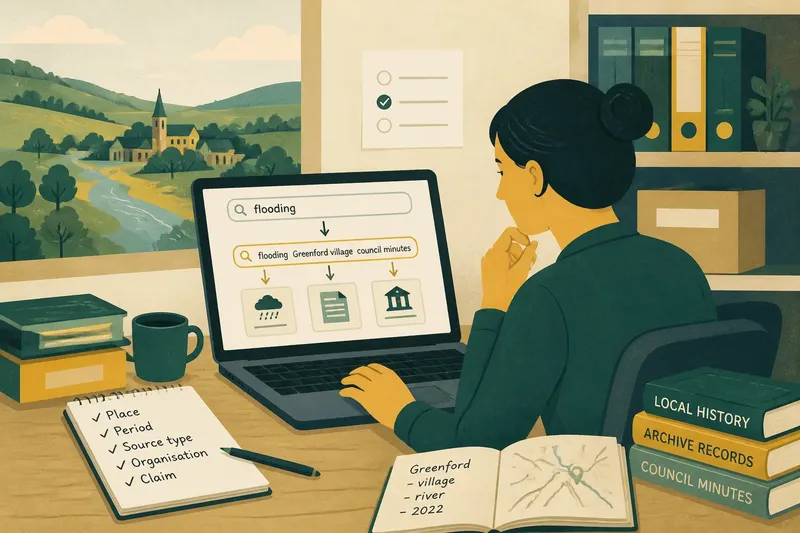
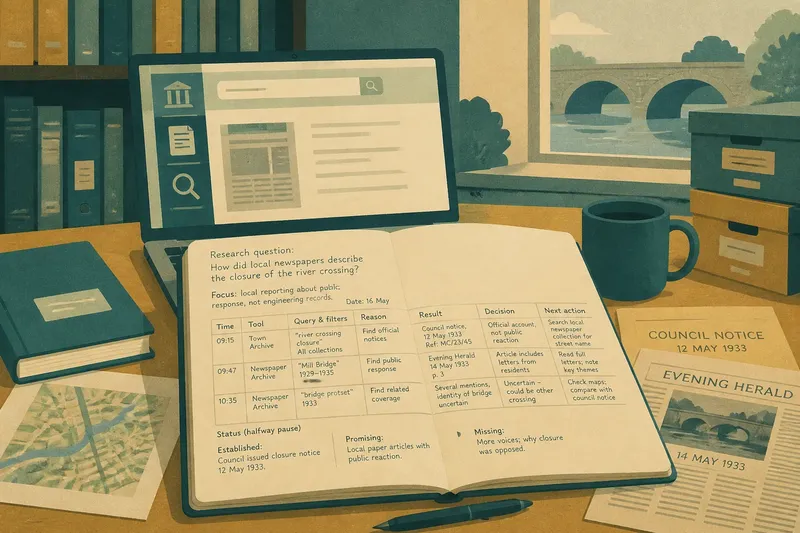
Start with a dated note that describes the question in ordinary language. Keep it narrow enough to guide a search, but broad enough to allow for unfamiliar terms. “How did local newspapers describe the closure of the river crossing?” is more useful than a bare topic such as “river crossing”.
Add a short boundary note: what would count as relevant, and what is outside the enquiry. For instance, you may be looking for local reporting about the public response, rather than engineering records about the structure. This distinction helps you recognise a promising result without treating every adjacent subject as part of the same trail.
Set up a small record for each search. A table is convenient, but separate entries in a text document are easier to expand. Include:
- Time or sequence: a time mark, or simply “search one”, “search two”.
- Tool: the catalogue, archive, database or search engine used.
- Query: the exact words and any filters applied.
- Reason: what you hoped this search might reveal.
- Result: a title, stable link, reference code or short identifying detail.
- Decision: why the result is useful, irrelevant or uncertain.
- Next action: the specific follow-up to take.
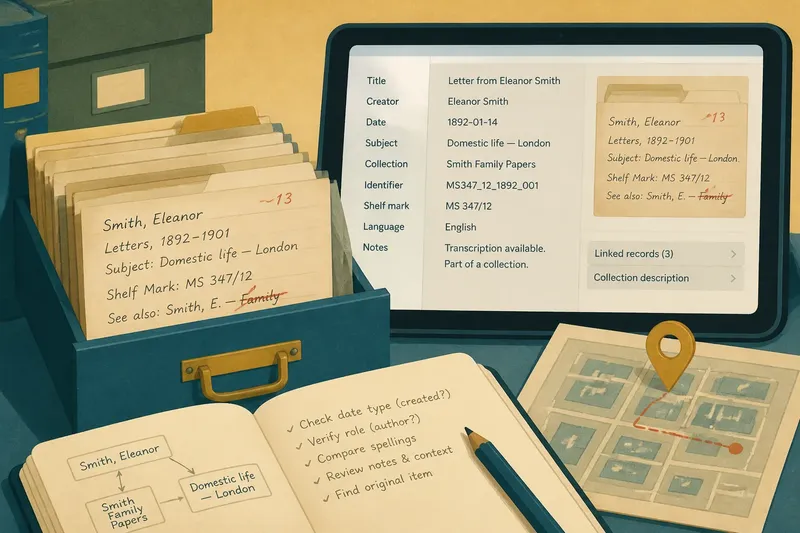
Record enough to find a result again. A title alone may be ambiguous; pair it with the source name and a link or catalogue identifier where available. If the platform’s sharing links are unreliable, note the collection and item reference as well.
During the search
Make an entry when a search changes direction, not after every minor adjustment. If you replace one term with a synonym, note the new wording when it produces a different set of useful results. If you add a date filter, record it. Later, that detail explains why a source appeared—or why an earlier query missed it.
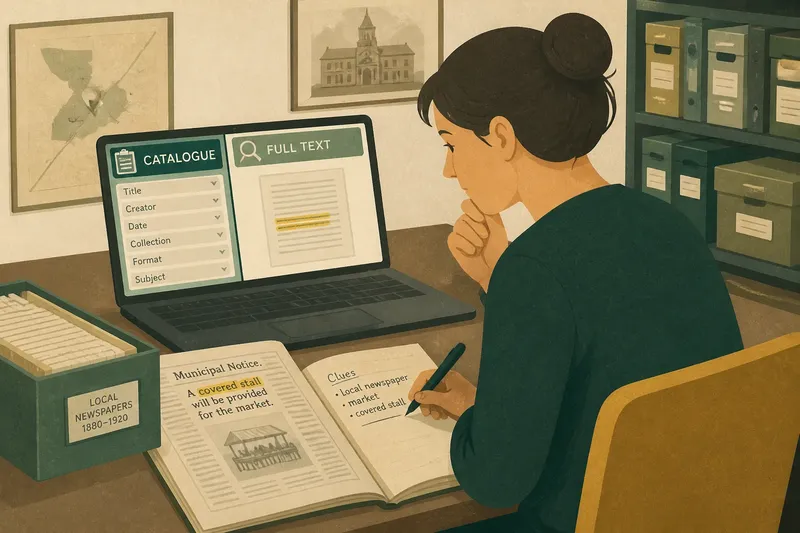
Separate the search itself from your judgement of its results. Write the query exactly as entered, then give a brief note on what the results contained. “Search for ‘river crossing closure’ in the town archive; results include council notices but not newspaper articles” is more informative than “nothing useful”. It also points towards a sensible next move: try the newspaper collection or search for the event’s local name.
For each promising item, save a compact note rather than copying a large passage. Record the item’s identity, the relevant section or page if visible, and the reason it may answer your question. Mark uncertain points plainly: perhaps a document refers to a different crossing, or its date is unclear. This keeps a possibility from becoming an assumed fact as the session grows.
Say you are tracing public discussion of a bridge closure and find a digitised council notice with no newspaper coverage. Your log records the phrase used, the municipal archive, the notice’s title and the observation that it gives an official account rather than public reaction. The next action might be to search the local paper collection for the street name mentioned in the notice. When you return, you can follow that lead without repeating the catalogue search or mistaking the notice for the answer.
At the halfway pause
After a substantial stretch of searching, stop briefly and read the log from the beginning. Do not polish it. Look for repeated queries, unexplained abbreviations and results saved without a reason. Add one sentence to clarify any entry that would be hard to interpret after a break.
Then write a small status note with three parts:
- What is established: observations directly supported by sources already located.
- What is promising: leads that may help but still need checking.
- What is missing: the part of the question the current material does not address.
This pause is useful because search sessions tend to accumulate material faster than they produce answers. The status note helps distinguish a genuine gap from a subject you have simply not searched yet. It also lets you change course deliberately instead of circling through familiar terms.
When should you record a result?
Should every query go in the log?
Record a query when it creates a new path, changes the result set in a meaningful way or rules out a line of enquiry. Minor wording edits that lead nowhere can be grouped in one note, provided you retain the useful final wording.
What should you save from a useful page?
Save the title, source, link or reference code, and the precise reason it matters to your question. Add a short location cue, such as a page heading or catalogue section, if it will help you find the relevant passage again.
How do you mark an uncertain source?
Describe the uncertainty rather than hiding it: identity unclear, date incomplete or connection to the question indirect. Put a follow-up beside it, such as checking a neighbouring record or comparing the item with another source.
What if you need to stop unexpectedly?
Write a restart note before closing the browser: the current question, the last useful result and the next action. Include the open tab’s title or link if it matters, rather than relying on browser history to explain why it was open.
At the end
Reserve the final few minutes for a handover to yourself. Write the next query in full, name the tool where you plan to run it, and state what a useful result would tell you. If you have several possible directions, put them in order and give the first one a clear reason.
Separate saved evidence from unfinished leads. A result can be worth keeping even when it does not answer the question; label it accordingly. Avoid turning the log into a second set of research notes. A link and a precise observation are usually enough to recover the source and understand its role.
Not worth the effort: recording every click, copying whole search-result pages or designing an elaborate colour system before you know what you need to track. Those tasks can make the log feel like a separate project. A few consistent fields and plain language are easier to maintain.
Close with a one-line session state, such as “official notices located; public response still untraced; next search: local paper archive using the street name”. That line is the part most likely to save time when you return. A personal search log works best when it preserves the reason for the next move, not merely the route already travelled.