Why Search Results Change When a Query Changes
Why search results change when a query changes: learn how wording shifts retrieval clues and how to refine a question without mistaking rank for quality.

Why search results change when a query changes is easier to understand if you treat each search as a new set of clues, not a fresh vote on the same question. Replace “river pollution” with “industrial discharge in the River Wye”, and a search tool has different words, relationships and possible meanings to match against its index.
The results can shift even when your underlying interest has not. A search engine does not read your mind; it interprets the terms you provide, connects them to material it has indexed, then orders the matches according to its own systems. That process makes wording consequential, but it does not make the resulting order a measure of truth.
Words act as clues
A query supplies signals. These can include the words themselves, their order, spelling, punctuation and any filters or search operators you use. The system compares those signals with information about available pages or records, such as their text, titles and other indexed details.
Some tools look for close matches to the complete wording. Others may account for related terms, common spelling variations, language or likely intent. A query for “jaguar habitat” may be understood as a question about an animal, while “Jaguar service manual” points towards a vehicle. The surrounding terms help resolve the ambiguity.
Small changes can therefore alter what the tool considers relevant. Adding a place name may bring local records into view. Replacing a broad word with a technical term may favour specialist material. Removing a term can open the search to records that were previously excluded, including useful ones and irrelevant ones.
Matching and ranking
Retrieval and ranking are related but distinct. Retrieval is the process of identifying material that may match a query. Ranking is the ordering of that material on the results page. A search tool can retrieve several plausible matches and still place one above another for reasons beyond the exact wording.
Those reasons vary by service. They may include how closely a page appears to match the query, how clearly its subject is represented, or signals about its usefulness to people making similar searches. A database or archive may use a much narrower set of rules, such as a match in a particular field. The same words can consequently produce different lists in different tools.
Ranking is also a practical response to limited attention: a results page cannot display every possible match at once. The order helps decide what appears first, but it cannot settle whether an item is accurate, current, relevant to your purpose or supported by suitable evidence. Read the result as a candidate worth inspecting, not as a verdict.
Context changes the match
Search tools often infer intent from the combination of terms, rather than treating every word as an isolated instruction. “Mercury exposure” is more specific than “mercury”, but the first phrase can still lead to material about different settings, such as household products, workplaces or environmental contamination. A further phrase can signal which context matters.
Imagine you are looking for council records about flooding near a particular village. A broad search for “flooding” may return weather coverage and general advice. Adding the village name and “council minutes” gives the tool a location and a likely document type. You would expect more local administrative records to appear, while still checking each result to see whether it actually concerns the village and the event you mean.
Context can come from the query, the service or both. A search engine may adapt to language or location settings; an institutional catalogue may use the collection’s own subject terms. These influences can help narrow a search, but they can also make two people’s result pages differ. If an item matters, record enough detail to find it again: the title, organisation, date shown and link.
Refine one clue at a time
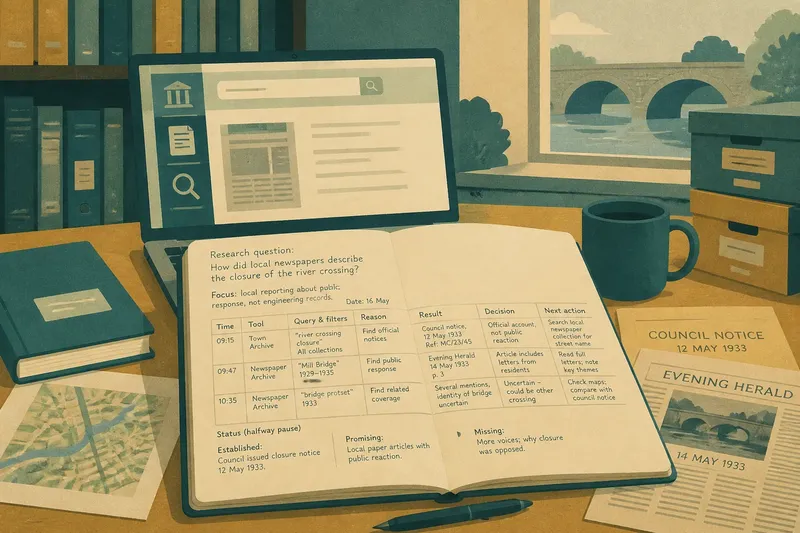
Useful refinement begins with the question behind the search. Decide what you need to identify: a place, a period, a type of source, a named organisation or a particular claim. Then change the query to express that need more clearly. Altering one element at a time makes it easier to notice which clue changed the results.
- Add a specific entity: include a person, place, organisation or product name when it is central to the question.
- Use the source’s likely vocabulary: try a formal term as well as an everyday one if the subject has specialist language.
- Signal the material you need: add a phrase such as “annual report”, “meeting minutes” or “dataset” when the format matters.
- Clarify the time or location: include a relevant year, period or place when it distinguishes your intended subject from similar ones.
- Remove a misleading term: if a word is drawing in the wrong topic, take it out or replace it with a more precise clue.
Say you need a public agency’s guidance on disposing of old paint. Searching “paint disposal” may mix household advice with industrial waste information. Adding the agency name or “household hazardous waste” should steer retrieval towards a more suitable context; then check the document itself for its intended audience and any local requirements.
There is little value in repeatedly swapping synonyms without a reason. If a new wording does not test a different meaning, source type or scope, it may simply produce a different-looking page without improving the answer.
What does a query change?
Why does one added word matter?
An added word can narrow the possible meaning or point towards a particular kind of source. Its effect depends on how the search tool interprets that term and how it is represented in the material it has indexed.
Do quotation marks always help?
Quotation marks commonly ask for a phrase or close word sequence, but their behaviour differs among search services. Use them when the exact wording matters, then try the phrase without them if the results seem too limited.
Why do two tools show different results?
Tools may search different collections, index content differently and use different ranking signals. A web search engine, a library catalogue and an archive database are not drawing on one shared list of material.
Can a changed result mean the earlier one was wrong?
Not by itself. A new query has changed the clues, so it may surface different matches; that shift says little about which result is accurate until you inspect the sources and their evidence.
Inspect the result itself
Before relying on a result, check whether its title and visible description match the question you meant to ask. Open the source where possible. Look for who produced it, what material it refers to, when it was issued or updated, and whether it distinguishes evidence from interpretation. A search snippet is a brief extract, not a substitute for the surrounding document.
When several results disagree, compare what each actually claims and the basis it gives. One may address a different place, time or definition despite using familiar words. Following the links back to the original record or document can clarify whether the disagreement is substantive or only apparent.
Knowing why search results change when a query changes gives you a modest but useful skill: you can shape the clues without treating the order as authority. Make each revision answer a specific question, and let the source—not its position on the page—carry the weight of the answer.